

Saunas were once a niche activity, usually found at spas, gyms, or during special vacations. Now, they’re much more common, with home infrared units, backyard barrel saunas, luxury wellness studios, and popular “heat and cold” contrast therapy routines.
It’s easy to see why saunas are popular. Sauna sessions offer immediate benefits like relaxation, looser muscles, and better sleep. There’s also more research, especially on traditional Finnish-style sauna use, showing regular sessions are linked to real health benefits. Most of the strongest studies are observational, so they show associations rather than proven cause-and-effect. Still, the results are consistent enough that many doctors consider the sauna a useful wellness tool when used safely.
Here’s what happens in your body during a sauna, the likely benefits, what’s often exaggerated, and why some people feel “off” afterward.
Just a quick note: This information is for general education, not medical advice. If you are pregnant, have heart disease, uncontrolled blood pressure, a history of fainting, or take medications that affect blood pressure or hydration, check with your doctor first.
What Happens to Your Body in a Sauna
Heat stress: your body reacts like it’s doing mild-to-moderate cardio
A sauna causes passive heat stress. As your skin and core temperature go up, your body works to keep you from overheating by turning on its cooling and circulation systems:
- Heart rate increases
- Blood vessels dilate (vasodilation)
- Blood flow shifts toward the skin
- Sweating ramps up
Many researchers say this pattern is similar in some ways to moderate exercise, especially for your heart and blood vessels, though it doesn’t replace actual training.
Circulation: vasodilation and “vascular exercise”
When your blood vessels widen, circulation gets better for a short time, and your blood pressure can change, often dropping after you cool down. Regular sauna use may help your blood vessels function better by improving their lining and reducing stiffness.
Sweat response: cooling first, “detox” second (and mostly a myth)
Sweating mainly helps your body control its temperature. Sweat is made up of water and electrolytes, with tiny amounts of other substances. While some things can show up in sweat, the idea that a sauna truly “detoxes” your body is exaggerated. Your liver and kidneys do most of the real work.
Physical Health Benefits
Cardiovascular support
The best-studied benefits of sauna bathing are cardiovascular and circulatory.
Large Finnish cohort studies have found that people who sauna more frequently had lower risks of fatal cardiovascular outcomes and all-cause mortality (again: association, not proof of causation).
There’s also evidence that saunas may help with blood pressure patterns and vascular health markers in specific populations. For example, studies have examined sauna exposure’s effects on blood pressure in people with hypertension and on vascular health measures in coronary artery disease contexts.
In simple terms, if you use a sauna regularly, it can be a real “heart-healthy habit” for many people, especially when it complements basics like exercise, sleep, and good nutrition rather than replacing them.
Metabolic effects: what it helps vs. what it doesn’t
Sauna can influence metabolism indirectly:
What it may help:
- Supporting recovery and sleep → better training consistency
- Improving stress regulation → fewer stress-eating spirals
- Short-term changes in heart rate and energy expenditure from heat stress
What it does not do (by itself):
- Create meaningful fat loss without diet/activity changes
- “Melt visceral fat” in a targeted way
People are still interested in passive heat therapy and living longer, but it’s best to see sauna as a helpful practice, not a quick fix for metabolism.
Skin, Face & Appearance Benefits
The real “sauna glow”
That post-sauna glow is mostly:
- Increased skin blood flow
- Temporary flushing
- A cleaner-feeling surface after sweating
Sweating can help remove debris and oil, and some sources say that saunas may reduce sebum on the skin. However, skin results vary from person to person, and the research isn’t as strong as it is for heart health.
If you feel less puffy after a sauna, it can be a mix of:
- Fluid shifts
- Reduced stress/inflammation feel
- Better sleep later
But you might also feel more puffy if you get too hot, don’t drink enough water, or your body holds onto water after heavy sweating. More on this later.
Collagen myths and “face tightening”
Sauna can make your skin look tighter temporarily due to:
- Heat-induced vasodilation
- Reduced surface tension from sweat + cleansing
- Post-session cooling “firming” sensation
But this isn’t the same as treatments that are proven to build collagen. Think of the “tightening” as a temporary look, not a lasting change to your skin’s structure.
Brain & Nervous System Effects
Why a sauna feels so good
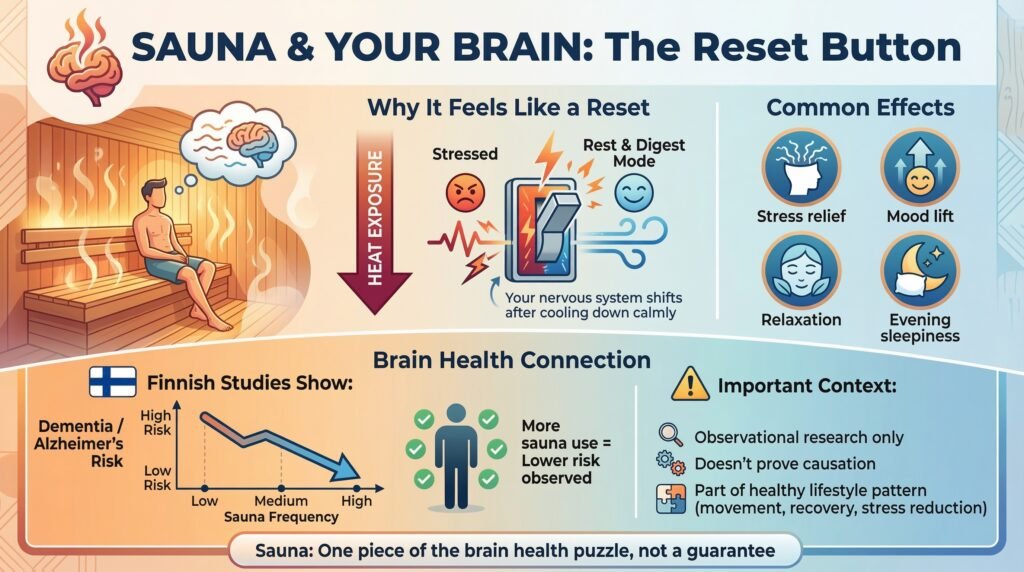
Many people say sauna feels like a “reset.” It isn’t just a feeling; heat exposure often helps your body switch to a more relaxed, “rest and digest” state after the session, especially if you cool down calmly.
Common reported effects:
- Stress relief
- Mood lift
- Relaxation
- Sleepiness later in the evening
Brain health: promising associations (not a guarantee)
Some well-known Finnish studies found that men who used saunas more often had lower risks of dementia and Alzheimer’s disease. This is interesting, but the research is observational, so it doesn’t prove that saunas prevent dementia.
A fair takeaway: sauna may be one part of a lifestyle pattern that supports brain health (movement, recovery, stress reduction), but it’s not a standalone shield.
Lymphatic, Digestive & Internal Health
Lymphatic “drainage”
The lymphatic system doesn’t have a pump like your heart; it relies heavily on:
- Movement
- Muscle contractions
- Breathing mechanics
- Fluid balance
Sauna may help you feel less congested by providing warmth, relaxation, and better blood flow, but it isn’t a magic fix for your lymphatic system. For real lymph support, combine sauna with gentle movement and staying hydrated.
Gut function and inflammation
People sometimes report better digestion after a sauna, likely due to:
- Relaxation response
- Stress reduction (stress can alter gut motility)
- Improved sleep quality downstream
But if you get too hot and don’t drink enough water, you might have the opposite effect: cramps, nausea, or slow digestion.
Fat Loss & Body Composition: What’s Real
“You can see this claim everywhere, but it’s usually misleading.
Your body indeed uses more energy to handle heat stress. But for most people, the calories burned in a sauna session are nowhere near what you’d burn with real exercise. Some research shows energy use depends on your size and how long you stay in, but a sauna isn’t a shortcut for fat loss.
Also, the most significant “scale drop” after sauna is usually water weight. That weight returns when you rehydrate.
Visceral fat + waist size myths
You can’t target fat loss with heat. If sauna helps you stick to your training, sleep, and recovery routines, it can indirectly support your body goals, but your overall lifestyle is what really matters.
A clean way to say it:
- Sauna can be a routine amplifier
- It is not a fat-loss engine
Why You Might Feel Puffy or “Off” After a Sauna
If a sauna makes you feel great one day but terrible the next, it’s usually because of one of these reasons:
1) Dehydration (and electrolyte loss)
If you sweat hard and replace only water (or replace nothing), you can end up with:
- Headache
- Fatigue
- Lightheadedness
- “Puffy” rebound water retention
- Poor sleep
2) Too much heat, too long, too soon
Many people start with 20 to 30 minutes at high temperatures before their body is used to it. That can cause:
- Nausea
- Feeling drained
- Poor recovery
3) Blood pressure drops after you stand up
Heat + vasodilation can set you up for a quick BP drop when you exit, especially if you stand fast.
4) You went in under-fueled or over-full
Both extremes can feel bad:
- Empty stomach + heat → woozy
- Heavy meal + heat → nauseated
5) You treated the sauna like “punishment”
Sauna is most effective when used calmly, not as an extreme challenge. If you’re forcing yourself through every session, you’re probably doing more than your body can handle.
Key Takeaways: Benefits vs Overhyped Claims
Benefits that are well-supported or strongly plausible
- Cardiovascular and vascular support (especially with regular use)
- Blood pressure and circulation effects in specific contexts
- Relaxation, stress relief, better sleep patterns (common and consistent)
- Skin “glow” and surface-clearing effects for some people
Claims to be treated as marketing more than science
- “Detoxing toxins” as the primary benefit
- Burning huge calories like a workout
- Targeting visceral fat or shrinking waist size from heat alone
The best way to think about a sauna
Sauna is a healthy habit that can help you feel better and stick to the routines that really make a difference.